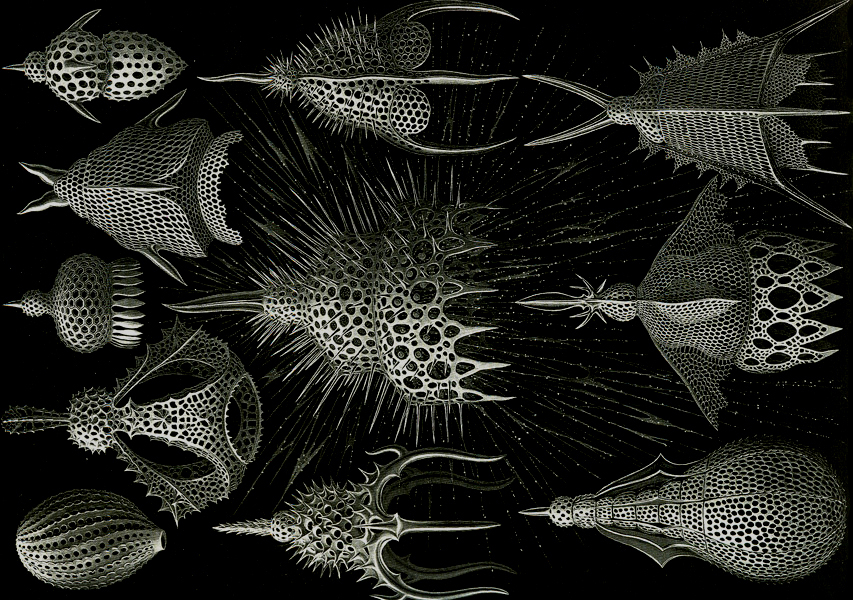

Reference Image: http://technoccult.net/
Case Study : Blur Building Swiss Expo 2002 by DILLER SCOFIDIO + RENFRO
Reading Text : A Thousand Plateaus by Gilles Deleuze and Felix Guattari
“Architecture as special effect” is the phrase that I felt in Blur Building. It is an Experience Architecture. There is no roof, no wall, only lightweight tensegrity structure. We actually cannot measure the real size of architecture because all 35,000 nozzles which are controlled due to the parameter of climate and weather generate the “mist and fog”. Each individual nozzle are controlled by senor of wind climate which effect water pressure to nozzle. Water works as primary material and particles that envelope architecture acts as movable and kinetic façade so called “Responsive Architecture”. In term of Topological Thinking, we can see the transformation from water into the mist and mist into the air, there are number of changes in the process of material properties.
Rhizome has big impact on parametric and digital architecture. It’s non-linear system which there is no beginning or ending. The input and output can enter from anywhere anytime. It is “the notion of network”. There will be no center called “Decentralization” which is a web of interconnected network.
The rhizome, of course, is their well-known image of a decentered system of points that can connect in any order and without hierarchy, a term drawn from botany that names a network of stems, like the strawberry plant, that grows horizontally and discontinuously by sending out runners. The logic of the rhizome is opposed to that of the tree, which is a hierarchical structure centered around a fixed root, a structure that grows continuously and vertically
My present interests is in the field of algorithmic architecture and generative design that has focused on agent-based models and the methodologies that focus on investigations spatial, structural and material organization in architecture and urbanism. I strongly believed that good architecture can embrace an intimate engagement between social and material interaction that concern in material performance and material life cycle.
In future research, I will use generative design process that can approach to environmental design by using multi-agent systems which capable of self-organizing into an emergent intelligence because it has the potential of the systems to negotiate between a complex set of desires and parameters in the generation of architecture.
Finally, my research line will explore more in algorithmic design methodologies and non-linear algorithmic design methodologies in developing complex systems and how these non-linear systems interact and operate within geometry in response to a set of architectural criteria.