Category Archives: Uncategorized

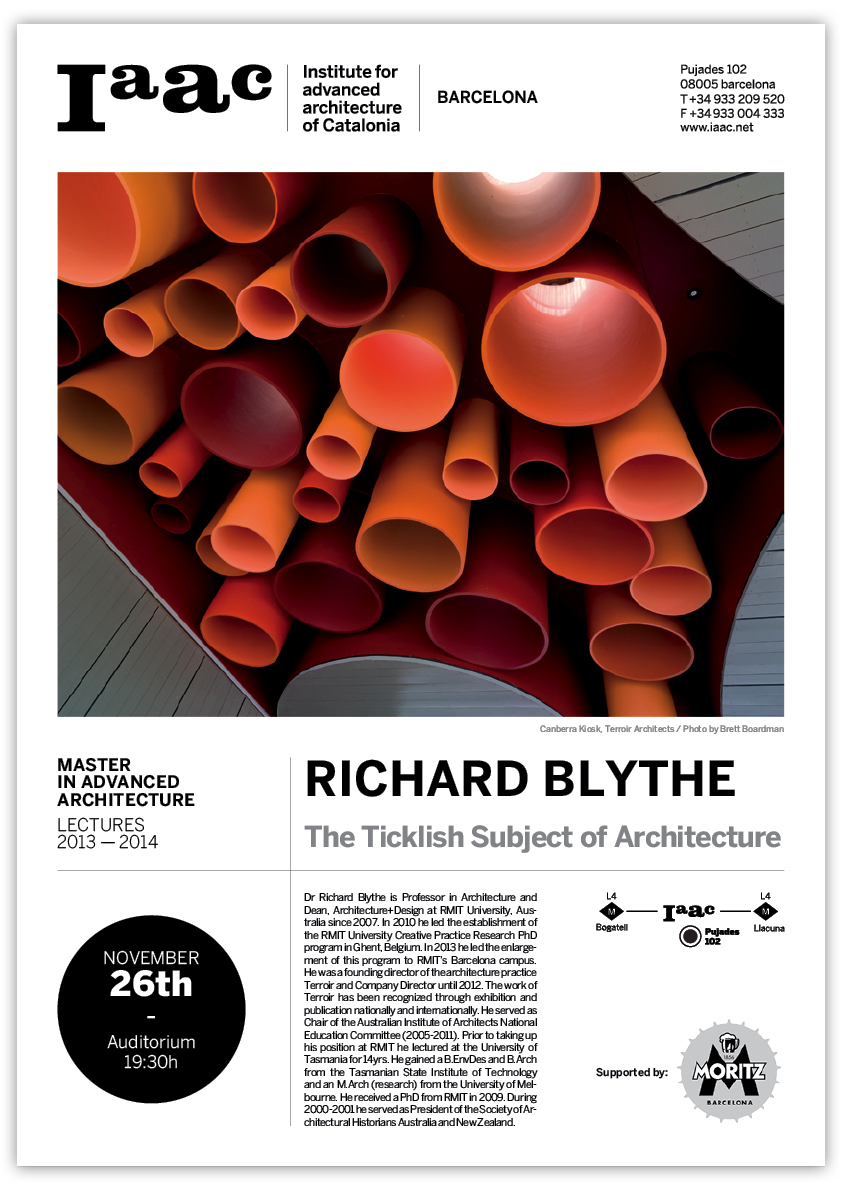
Tuesday 26th of November: RICHARD BLYTHE – THE TICKLISH SUBJECT OF ARCHITECTURE

blythe-sombra1

Tuesday 26th of November 2013
Richard Blythe
Lecture: 
The Ticklish Subject of Architecture

@ 19.30, IAAC Auditorium
Open to the Public

RICHARD BLYTHE
Dr Richard Blythe is Professor in Architecture and Dean, Architecture + Design at RMIT University, Australia a position he has held since June 2007. In 2010 he led the establishment of the RMIT University Creative Practice Research PhD program in Ghent, Belgium and was the primary author and lead researcher for the 2013 €4M EU Marie Curie ITN grant ADAPT-r. In 2013 Richard led the enlargement of this program to RMIT’s Barcelona campus. Richard was a founding director of the architecture practice Terroir and Company Director until 2012 and continues to contribute to the Terroir team. The work of Terroir has been recognized through exhibition and publication nationally and internationally.
Richard served as Chair of the Australian Institute of Architects National Education Committee from 2005-2011 and his most important achievements in that role were: leading the development and adoption of the AIA Research Policy and associated documents; implementing and refining the AIA’s Education Medal, now known as the Neville Quarry Architectural Education Prize. Richard’s academic passion is creative practice, developing approaches to creative practice research and in building communities of creative practitioner researchers. Richard undertook a Velux visiting professorship in Aarhus, Denmark in 2011.
Prior to taking up his position at RMIT Richard lectured at the University of Tasmania for 14yrs where he served as Deputy Head of the School of Architecture and was the Vice Chancellor’s representative on the Tasmanian Government’s Building and Construction Industries Council. Richard gained a B.EnvDes and B.Arch from the Tasmanian State Institute of Technology and an M.Arch (research) specializing in twentieth century Australian architectural history from the University of Melbourne. Richard received a PhD from RMIT in 2009. During 2000-2001 Richard served as President of the Society of Architectural Historians Australia and New Zealand.
Posted in Uncategorized | Leave a comment

BEN FLANNER LECTURE – Brooklyn Grange

Today we had the pleasure of hosting a Lecture by Ben Flanner, the head farmer and CEO of Brooklyn Grange. during the Lecture Ben described the many facets and projects of the Brooklyn Grange, a 2.5 acre rooftop farm in New York City.

As the population in cities rise, these appear to be evermore removed from nature. The farms therefore help us understand what role nature can potentially play in the city for the future.

The first rooftop farm was opened in May 2010 in Queens, on the roof of an ex-industrial building, in one of the cities up and coming spaces, where people started to move, from Manhattan, mainly for economic reasons.

The second farm, at the Brooklyn Navy yard, was then opened in May 2012, bringing production back into the city, in an affordable manner.

The project took the model of the green roof, and expanded this concept to a concrete and commercial farming operation. The model of a green roof refers to a model where vegetation is placed over the waterproofing membrane of an existing roof. This model brings with it a series of benefits that better the urban landscape, and its population, from a series of points of view: these allow to capture stormwater, allowing to minimise sewage over flow, transforming the city into a “sponge”, allowing it to capture water; it increments the building’s insulation; it helps combat the heat island effect, lowering the city’s temperature; it extends the life span of the roof, and inparticular its waterproof membrane; and finaly, it represents a real estate tax credit to the landowner.

The lecture then proceeded to explain how the farms work with respect to a series of topics, including:

- Growing, selling, and distributing food in a city, the farm being located in the city offers a 0km distribution, therefore also reducing emissions related to the distributions of its produce;

- The structural and engineering requirements for rooftop farm, with respect to the diverse layering neceassary and possible methods to install a green roof;

- Architectural requirements and important factors to consider – such as egress, structure engineering, fire code, municipal filing and tax credits;

- Social and community programs, such as the City Growers;

- Children’s nutritional education, as Diet, particularly in the United States, is a big issue that calls to be dealt with, as calories have an all time low cost, generating a stuation where people are poisoning their body at a very affordable price;

- Organic farming education and training programs, resulting in one of the more important long term factors of the project;

- Events, rooftop dinners, weddings, and the many entrepreneurial activities which occur at the farm;

- Finances – startup costs, ongoing challenges.

The Lecture was wrapped up with a question and answer period, where we discussed how city leaders and planners can learn from the Brooklyn Grange project to incorporate important environmental and community factors into design.

Read More »

Posted in Uncategorized | Leave a comment

Workshop – Does self-sufficient real estate exist?

Since 2008 the world has changed. The economic system has undergone all kinds of system failures. So far we have seen the meltdown of the housing industry, bank savings, big organizations, companies and so on. But we have also witnessed new initiatives that are based on alternative financial models, informal currency systems and community based sharing models. In Spain the organization of ‘the informal’ has always been fairly well developed. The Netherlands is experimenting with vacant real estate objects and finding ways to implement new approaches in existing structures and organizations.

Workshop Development:

Does self-sufficient real estate exist?

IaaC and Jaula de Elefantes together organized the “Does self-sufficient real estate exist?” workshop consisting in 4 intense days held at the Valldaura Self-Sufficient Labs.

Ten Dutch and Spanish architects and developers gathered to discuss new strategies in the face of the crisis.

The particpants worked in groups towards the development of three urban projects in Holland, areas of potential, that emerged in this moment of crisis, to which they applied self-sufficient strategies.

The Scheveningen docks, the IJburg 2 artificial island and the public space in front of the Sloterdijk Station.

Some of the questions that arose from the workshop regard how to extend self-sufficiency the dense city, remaining efficient economically? How can self sufficiency be a political tool? And what is a suitable scale to generate self-sufficient communities?

The workshop was closed with a presentation with an invited jury, and a visit to the Endesa Pavilion (IAAC, 2011). Read More »

Posted in Uncategorized | Leave a comment

Vote for the People’s Choice Award – 5th Advanced Architecture Contest

AAC_5.140c069
In parallel to the 5th Advanced Architecture Contest, the Institute for Advanced Architecture of Catalonia (IaaC) and Hewlett-Packard are also running the international People’s Choice Award.

On IaaC’s Facebook page, inside the 5th Advanced Architecture Contest Album, vote by giving “like” to the picture of your choice. The most popular image will win an HP Designjet web connected Printer.

The People’s Choice Award will be open untill December 1st 2013.

The 5th Advanced Architecture Contest aimed to generate, through research and discussion, new insights, visions, ideas and proposals to help us envisage what the city and the habitat of the 21st century will be like.

Posted in Uncategorized | Leave a comment

Studio “Wind energy machines” visit to the experimental wind labs of TechnoWind

Today the MAA students of the Introductory Studio “Wind energy machines” Tutored by Javier Peña, Rodrigo Rubio, Oriol Carrasco and Stefanos Levidis have visited the experimental wind labs of TechnoWind, located in Sant Guim de Freixenet (Lleida).

Alvaro Ibañez and Josep Maria Pujol showed us the instalations that Technowind use to test their windmills, Technowind by Ficosa Renovables is a young company that offer energy solutions, specialized in hybrid systems composed by solar panel and windmills. The headquarters are located in in Rubí (Barcelona), where they design and fabricate vertical axis windmills .

In Sant Guim de Freixenet, the group has the i+D lab, where they test the new models of wind turbines and new prototypes with different solutions in design . The biggest windmill that is being tested in the wind lab is able to generate 5Kw without any kind of noise.

The visit ended under a horizontal axis wind turbine that allowed students to realize and understand one of the most important concepts of the introductory studio: energy scales.

Read More »

Posted in Uncategorized | Leave a comment

IAAC @ Nuqat, Kuwait

IAAC was invited to be part of the Nuqat, Platform for Creatives in the Middle East, represented by IAAC MAA Director Areti Markopoulou, Fab Lab Bcn Coordinator Anastasia Pistofidou and Yousef Alnafisi, IAAC Alumni from Kuwait. Areti and Anastasia are speakers at the Conference, as well as heading a workshop on 3D Printing. Have a look at how its been going so far!

Read More »

Posted in Uncategorized | Leave a comment

Visit to the algae bioreactor and constructed wetlands of the GEMMA

Today the MAA students of the Introductory Studio “When Energy Becomes Form” directed by Claudia Pasquero, Marco Poletto and Carmelo Zappulla, visited, with professor Silvia Bures, the algae bioreactor and constructed wetlands of the GEMMA- Group of Environmental Engineering and Microbiology at the Dept. of Hydraulics, Maritime and Environmental Engineering of Universitat Politècnica de Catalunya, in Barcelona. The students were received by professor Joan Garcia, Head of the Department and director of the experiments, and also by Clara and Raquel, the PhD students working on the systems.

The installations, in the terrace of the University Building at Campus Nord,  consist of a couple of algae bioreactors that treat wastewaters from the University area. The algae grow by catching the sun’s energy in form of Photosynthesis, and are fed by the nutrients dissolved in the wastewater. Periodically, the algae biomass is collected and it is transferred to a laboratory, were it is digested anaerobically to obtain biogas.

Also in the terrace the students could visit a series of constructed wetlands that are also used for treating wastewaters. In one of them they have installed a pair of electrodes that catch the energy from the redox reactions produced by the microbial activity that are in the soil.

Read More »

Posted in Uncategorized | Leave a comment