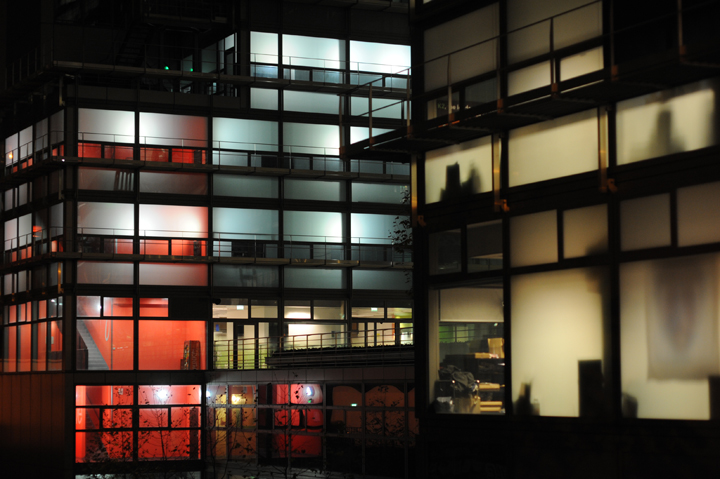
FRANCIS SOLER // El arte de la Oposición

Tonight we had the pleasure of hosting Francis Soler as part of the IaaC Winter Lecture Series 2014 entitled the Art of the Opposition, during which Soler discussed his works, and his thoughts developed throughout his career.

Marc Barani describes Francis Soler in the following extract:

« I remember a drawing on the cover of an architecture magazine. It was back in 1986. With a nerve, Francis Soler drew support from the structuralist approach to explore an unusual aesthetic world that was flexible, living and rational. As a result, the plans, sections and details of his projects demonstrated uncompromising functional and constructive precision, an economy of means, while the volumetry, façades and atmospheres captured the context and culture of the period. This fertile tension, between structuralism and sensuality, and between rationality and poetry, was the basis of his work. On this doctrinal foundation, Francis Soler achieved the miracle of developing a very personal timeless type of architecture. Those who know how to do this are few and far between; all the more so since this talent is combined with that of a pioneer. Indeed he proposed to cover all the buildings for Les Bons Enfants – the seat of the Ministry of Culture – with a vibrant and unifying latticework. That was in 1994, well before this solution was taken up in many projects. Still in 1994, he designed the Lycée in Noumea from a sophisticated natural ventilation system, without following the program, which required air-conditioning, to the point of being excluded from the competition.In 1999, for the conversion of the Keroman submarine base in Lorient, he located a wind farm on a rough site where water and concrete meet. It was a “utopia”, according to the jury. Yet this utopia would have provided the city of Lorient with half its electricity requirements, and whose feasibility was confirmed by a letter from EDF in which they undertook to finance the project. At the time, these proposals earned him incomprehension, mockery and virulent criticism. They are now an integral part of the architectural landscape. In Francis Soler’s more recent projects, the strong narrative dimensions he began with tend to fade before a more direct and technical representation. It would seem that the proliferation of standards and regulations of all sorts is a driving force in their design. A beneficial opposition to the pervading exasperation to describe the growing number of constraints differently, recognize that despite it all they are revealing of a contemporary culture, and from this create new arwchitectural material. Today, Francis Soler’s constant search for innovation drives him to design projects like a scientist, to set them up like far-reaching and generous precision engineering, capable of adapting to the prevailing cultural instability. He is a pioneer as I already said. It would probably be appropriate to ask what he is telling us that we have not yet seen or understood. »
Read More »

Posted in Uncategorized | Tagged , , , , , , | Comments closed

Shigeru Ban 2014 Laureate // El Premio Pritzker de Arquitectura

Congratulations to Shigeru Ban who has been nominated the 2014 Laureate for the Pritzker Architecture Prize!

Shigeru Ban visited IaaC in 2011, as part of the 2011 IaaC Winter Lecture Series, presenting a Lecture entitled: ¨ Works and Humanitarian Activities ¨.

In his presentation, Mr. Ban shared a series of his projects with the audience such as: the Paper House, the Nomadic Museum, the Centre Pompidou-Metz and more. In the development of the Lecture Mr Ban elaborated both the conceptual background that supports these projects, as well as input regarding the Structural Performance of each one. He explained the influence of modernism, in particular Mies Van de Rohe, in terms of transparency and structural strategies, on his projects, using the Farnsworth house and the Barcelona Pavilion as main examples.

The Lecture took place just one week after a devastating Earthquake in Japan, and it was interesting to see how Shigeru Ban is in fact greatly involved in humanitarian works developing with disaster relief projects such as Paper Log House (Kobe of Japan in 1995, Turkey in 2000, India in 2002), Paper Church (Kobe,1995), Tsunami Reconstruction Project (Kirinda, Sri Lanka, 2005), Temporary Elementary School (Chengdu, China, 2008), L’Aquila Temporary Concert Hall (L’Aquila, Italy, 2011) and his proposal for temporary shelters in Japan (Onagawa, Japan, 2011).

To watch the Lecture, CLICK HERE.

Read More »

Posted in Uncategorized | Tagged , , , | Comments closed

Presentaciones Segundo Plazo // Estudios de Investigación

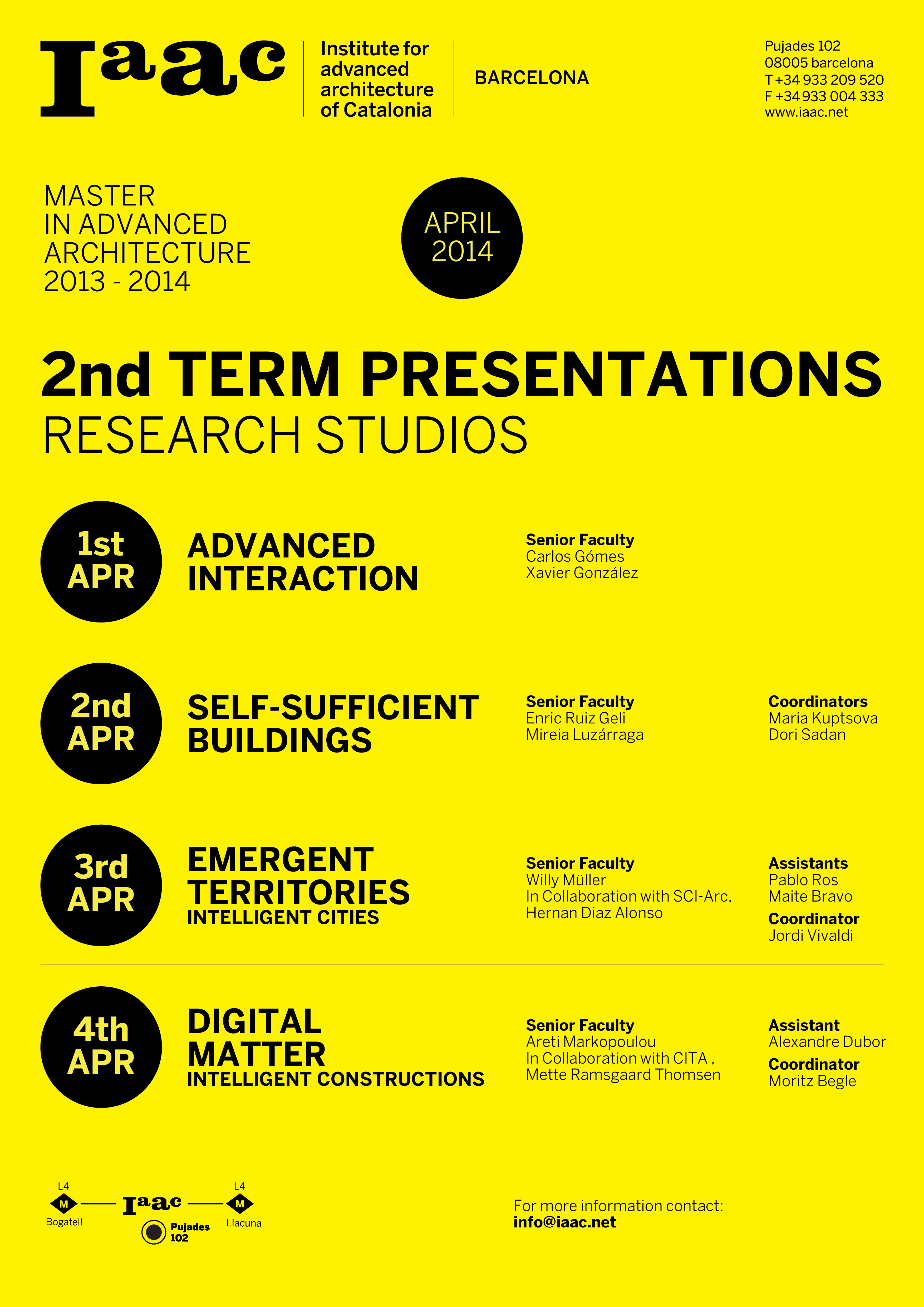
2nd-term-presentations-defCC

The 2nd Term Presentations for the Research Studios will be taking place next week in IaaC. Each Studio will present to a select international jury on the following dates:

01.04.2014 // ADVANCED INTERACTION

02.04.2014 // SELF SUFFICIENT BUILDINGS

03.04.2014 // EMERGENT TERRITORIES – INTELLIGENT CITIES

04.04.2014 // DIGITAL MATTER – INTELLIGENT CONSTRUCTIONS

For more information, contact: info@iaac.net

Posted in MAA 2013-2014 | Tagged , , , , , , , , | Comments closed

IaaC @ DHUB para DEMO-Día

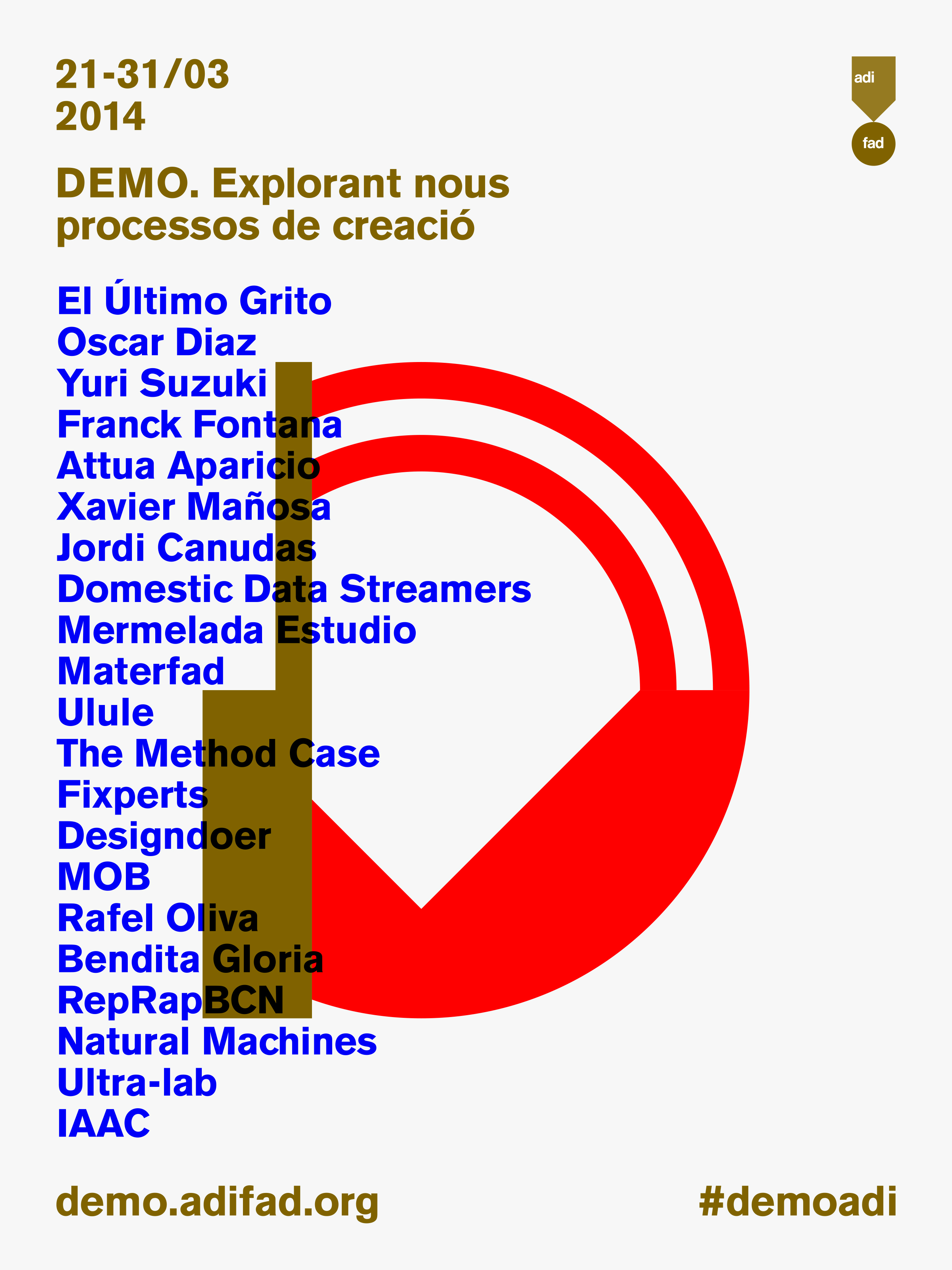
DEMO_01


DEMO-Day @ DHUB

22nd of March

The Auditorium of DHUB will be dedicated to the elaboration and discussion of new perspectives, the relationship between user and object and new productive scenarios regarding the themes ofGLOBAL – DATA – EDITION – PROCESS – MATERIAL – HIGH vs LOW.

4pm -5.30pm // MATERIAL

IaaC will be featured in the MATERIAL section of the Day during which Masters Director Areti Markopoulou will give a talk regarding the potentials, research and investigation of 3D Printing applied to the architectural field.

IaaC will be feature along side MaterFad and HYBRIDaSCP.

We hope to see you there!

For more information on DEMO-Day, please visit:

demo.adifad.org 

Posted in Uncategorized | Tagged , , , , , , , , , | Comments closed

Jueves 27 de marzo: FRANCIS SOLER – El Arte de la Oposición

Les-Frigos-L.Vasconiblog

Thursday 27th of March 2014
Francis Soler
Lecture: The Art of the Opposition.

@ 19.30, IAAC Auditorium
Open to the Public

FRANCIS SOLER
Francis Soler set up his private practice in 1985. Its activities are extremely varied: from facilities to housing and from studies to urban development. The office takes part in major competitions for public projects both in France and abroad and in consultations by invitation. As much attention is given to small but remarkable buildings, such as public housing in Rue Emile Durkheim (Paris/Delivery in 1997), and in Clichy (delivery in 2001), layouts, and facilities, as to high prestige works, such as grandstand for 14 July celebrations (under François Mitterrand mandates), International conference centre (aborted project), Ministry of Culture (delivery in 2005), OCO / “Coeur d’Orly”, big urban airport project and Philharmonics of Paris (competitions).
In 2009, he participated in the elaboration of Vasconi report, ordered by Minister of Ecology Jean-Louis Borloo about environmental challenge and the discussion about placing architecture under supervision of this ministry and not Ministry of Culture.
His big project of Research and Development Centre for EDF (French Electricity) is actually under construction (delivery is scheduled in 2015). His private housing project for VINCI, in Zac Cardinet (Paris) is also under construction (delivery by 2015). The construction of his big public housing projects, in Porte d’Auteuil (Paris) with Anne Demians, Rudy Ricciotti and Finn Geipel architects is scheduled to begin in mid-2014. Executive studies for the construction of the huge bridge over the Arno River Florence, (Italy) are almost achieved and approved, construction being scheduled by the end of 2014.
The aim is to give them all an important role in the city, to make them into art works. Whatever the project is, Francis Soler’s priorities are to propose pertinent responses to the complex problems of old and new cities, and to give real pleasure to users and residents by offering them architecture that is an art of usage.

Posted in Lecture Series | Tagged , , , , , , , | Comments closed

Physical Computing Seminar Finals

Tonight we had the Physical Computing – Internet of Things Seminar led by Alex Posada and Guillem Camprodon End of Term Presentation.

Nowadays the physical computation, the electronics and the new technologies every time have more presence in the architecture. Some items, like the systems of optimization of energy, the light installations that increase architectural elements with the use extended of the LED, or devices that extract information of the environment and apply it in a creative form to the buildings, and sensitive spaces that react to the persons, they are some examples of applications of the technology in this field.

Open source electronics such as Arduino and online communities have helped in the generalization and democratization of knowledge in the last decade. This technology has endowed architects, designers and artists with cheap, powerful tools, as well as being incredibly easy use towards the development of ideas in a rapid and efficient form without the need of contract the services to external companies or investing big quantities of money in environments of development that are expensive and inflexible.

Using these techniques the students presented their projects consisting in the design and development of a physical module with common elements creating an interactive application together, as well as a modular and scalable system.

Read More »

Posted in IAAC event | Tagged , , , , , , , , , , | Comments closed

Diseño e Impresión 3D: Nuevos campos de Aplicación Conferencia @ DHUB de Barcelona

Today at DHUB, a Conference day was dedicated to “Design & 3D Printing: New fields of Application” organised by ASERM, DHUB and the Barcelona City Council.

Additive fabrication presents great potential of growth in many industrial sectors, as well as in the fields of research, space, health and art.

Thanks to the versatility of additive fabrication techniques, in recent years new product concepts have been developed, as well as marketing opportunities linked to these that open the possibility to new business models (customised fabrication, bio materials, intelligent products).

The day itself was dedicated to the generation of a comprehensive view, through a multidisciplinary approach, of the opportunities that arise from the additive fabrication technology.

In this occasion Master Director Areti Markopoulou gave a lecture regarding the development of 3D printing in the architectural field, illustrated through the research and development of said tool by IaaC researchers, with a projection of what this tool could allow us to do in the future.

Read More »

Posted in IAAC event | Tagged , , , , , , , , , , , | Comments closed