Digital Materia Studio – Investigación de viaje a Copenhague

The students and Tutors of the Digital Matters Research Studio have gone to Copenhagen to partake in a Workshop organised in collaboration CITA from the 3rd to the 7th of March.

The professors and tutors leading the 4 groups of students, both from CITA and IaaC, are: Prof. Christoph Gengnagel (UDK), Julien Nembrini (UDK), Mette Ramsgard Thomsen (CITA), Paul Nicholas (CITA), Martin Tamke (CITA), Anders Deleuran (CITA) , Areti Markopoulou (IaaC), Alexandre Dubor (IaaC) and Moritz Begle (IaaC).

The workshop is developed to investigate a further an understanding of material systems as being based on discreet energetic systems that negotiate flows of energy. The forces and emerging behaviour of the system are understood and simulated as well as used in a designerly way.

The investigation is centred on how materials and their properties can be modeled, chosen and programmed to influence a material system in a target oriented way.

The overarching concepts and computational techniques are exemplified and investigated in a structural system that negotiates the forces from programmed bending active elements and a tensile surface with variable geometry.

The IaaC students and tutors arrived in Copenhagen on Saturday, and started off their stay with a bicycle tour visiting the VM Houses, 8 taller, VM Mountain, Hotel by 3XN, as well as Christiania.

They then went to CITA where an introduction to the workshop, including the design task and diverse materials to be investigated. The students were then divided into their working groups, and started developing their specific tasks towards the creation of their first models.

Read More »

Posted in IaaC Life, Uncategorized | Tagged , , , , , , , | Comments closed

Conferencia a cargo de MASSIMO BANZI – sourcing innovación abierta

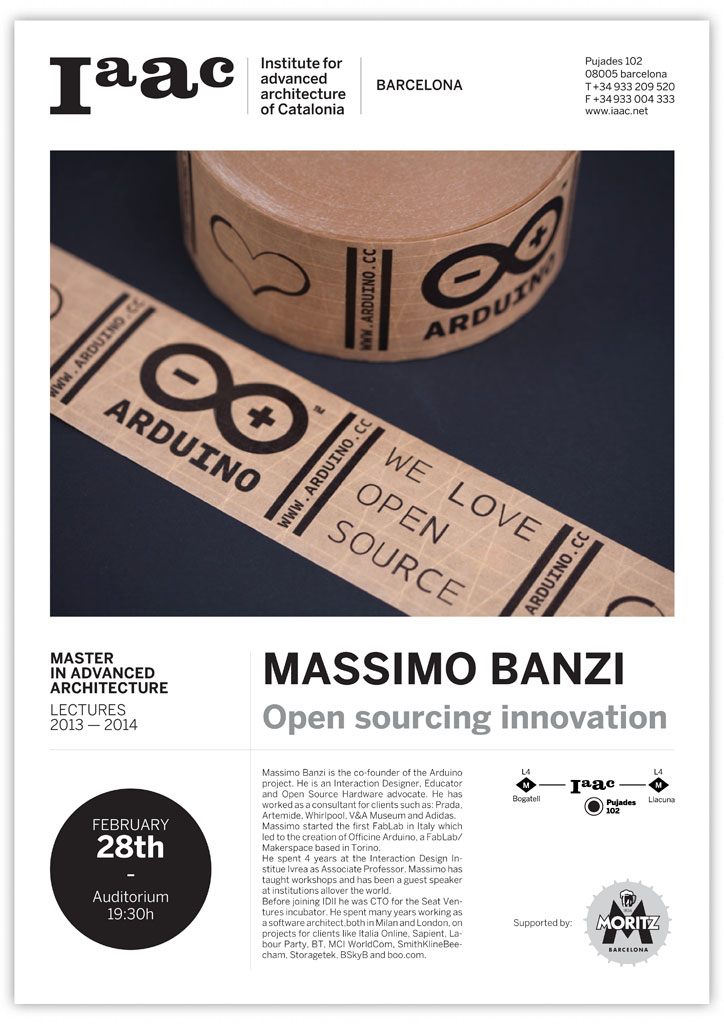
Last Friday we had the pleasure of hosting the Winter Lecture Series 2014 with Massimo Banzi.

Massimo Banzi is the co-founder of the Arduino project. He is an Interaction Designer, Educator and Open Source Hardware advocate. He has worked as a consultant for clients such as: Prada, Artemide, Persol, Whirlpool, V&A Museum and Adidas.

Massimo started the first FabLab in Italy which led to the creation of Officine Arduino, a FabLab/Makerspace based in Torino.

He spent 4 years at the Interaction Design Institue Ivrea as Associate Professor. Massimo has taught workshops and has been a guest speaker at institutions allover the world.

Before joining IDII he was CTO for the Seat Ventures incubator. He spent many years working as a software architect,both in Milan and London, on projects for clients like Italia Online, Sapient, Labour Party, BT, MCI WorldCom, SmithKlineBeecham, Storagetek, BSkyB and boo.com.

Massimo is also the author of “Getting Started with Arduino” published by O’Reilly. He is a regular contributor to the italian edition of Wired Magazine and Che Futuro, an online magazine about innovation.

He currently teaches Interaction Design at SUPSI Lugano in the south of Switzerland and is a visiting professor at CIID in Copenhagen.

Read More »

Posted in Lecture Series | Tagged , , , , , , , , , | Comments closed

Viernes 07 de marzo: Mose RICCI – Aprender de Detroit

DETROIT_abandonment2_by J Sordi

Friday 7th of March 2014
Mosè Ricci
Lecture: Learning from Detroit.

@ 18.00, IAAC Auditorium
Open to the Public

The lecture Learning from Detroit with Mosè Ricci, is not only part of the IaaC Winter Lecture Series 2014, but is also part of an international conference on theory and landscape: Landscape and Emotion, the revival of emotional geographies organised in collaboration with Universitat Pompeu Fabra and Observatori del Paisatge.

MOSÈ RICCI
Mosè Ricci (Florence, 1956) –Emeritus of Italian Art and Culture since 2003– is Full Professor of Urbanism at the University of Genoa and of Lanscape Architecture at the University of Trento. He graduated in architecture in 1982 at La Sapienza University of Rome (Italy).
He became Researcher Professor (1984), Associate Professor (1997) and Full Professor (2001) at the Pescara School of Architecture (Italy). In 1996-1997 he was Fulbright Recipient and Visiting Scholar at GSD (Harvard University, USA, Visiting Professor of Sustainable Urbanism at Universitad Moderna de Lisboa (2006-2007) and at Technische Universitat of Munich (2008-2009).
Since 1999 he is member of the Scientific Board of the Villard International Seminar and since 2004 of the Villard International Doctorate. He has been member of Italian Society of Urban Planners Steering Committee (2003-05, 2007-11). Since 2010 he is member of the Mies Foundation Mediterraean Program Board.
He was member of the Scientific Committee and curator of the Urbanism and Landscape section of the international exhibition Recycle, Strategies for Architecture, Cities and Planet (MAXXI. 2010-12). In 2012 he has been ranked in the top 100 World Educators by the Cambridge Institute.
Posted in Lecture Series | Tagged , , , , , , , | Comments closed

Conferencia a cargo de SIMON SCHLEICHER – Mecanismos Bio-inspirado – Diseño con flexibilidad

Thursday 20th of February we had the pleasure of hosting the Winter Lecture Series 2014 with Simon Schleicher.

In architecture, kinetic structures enable buildings to react specifically to internal and external stimuli through spatial adjustments. While these mechanical devices come in all dimensions, they are conceptualized as uniform and standardized modules. Typically, they gain their adjustability by connecting rigid elements with highly strained hinges. Even though this construction principle may be generally beneficial, it has some major drawbacks for architectural applications. Adaptation to irregular geometries, for example, can only be achieved with additional mechanical complexity, which makes these devices often very expensive, prone to failure, and maintenance-intensive.

Simon Schleicher is searching for a promising alternative to the still persisting paradigm of rigid-body mechanics and has found inspiration in flexible plant movements. By using modern computational modeling and simulation techniques, he can reveal the plants’ compliant mechanisms and integrate them into bio-inspired flexible structures. In various case studies, he demonstrates the transfer process in more detail and shows how bio-inspired mechanisms can be used, for example, to shade double curved facades.

Read More »

Posted in Lecture Series | Tagged , , , , , , , | Comments closed

La experiencia HTC Barcelona Design visita IaaC

Today IaaC had the pleasure of hosting a group of journalists as part of HTC’s Barcelona Design Experience.

The group, including journalists from the UK, Germany, Russia and Spain, toured IaaC together with MAA Director Areti Markopoulou and Alexandre Dubor (Research and Development).

The main interest of the tour regarded additive manufacturing. The journalists were able to observe prototypes and projects, all developed in IaaC, in action. Read More »

Posted in IaaC Life, Uncategorized | Tagged , , , , , , , , | Comments closed

Viernes 28 de febrero: MASSIMO BANZI – sourcing innovación abierta

massimo-banzi-sombra2

Friday 28th of February 2014
Massimo Banzi
Lecture: Open sourcing innovation.

@ 19.30, IAAC Auditorium
Open to the Public

MASSIMO BANZI
Massimo Banzi is the co-founder of the Arduino project. He is an Interaction Designer, Educator and Open Source Hardware advocate. He has worked as a consultant for clients such as: Prada, Artemide, Whirlpool, V&A Museum and Adidas.
Massimo started the first FabLab in Italy which led to the creation of Officine Arduino, a FabLab/Makerspace based in Torino.
He spent 4 years at the Interaction Design Institue Ivrea as Associate Professor. Massimo has taught workshops and has been a guest speaker at institutions allover the world.
Before joining IDII he was CTO for the Seat Ventures incubator. He spent many years working as a software architect,both in Milan and London, on projects for clients like Italia Online, Sapient, Labour Party, BT, MCI WorldCom, SmithKlineBeecham, Storagetek, BSkyB and boo.com.
Posted in Lecture Series | Tagged , , , , , , , , , , , , , , | Comments closed

Anupama KUNDOO junto con IAAC diseñará una instalación efímera en Barcelona

BCN Re.set - Ephemeral Architecture in the Public Space

During next summer the public space of Barcelona will be transformed by six ephemeral installations designed by six international architects, in cooperation with the leading architecture and design schools in Barcelona. IAAC will be collaborating together with the Indian architect Anupama Kundoo for the construction of an ephemeral architecture in Raval – Barcelona.

The architect Benedetta Tagliabue (EMBT/Fundació Enric Miralles) and the stage director Àlex Ollé (La Fura dels Baus) will lead and coordinate this intervention in Barcelona, as part of the events programmed to commemorate the Tercentenary BCN. Within this event some of the most outstanding public spaces in Barcelona will be altered by a series of seven artistic and architectural installations reflecting on such concepts as identity, freedom and democracy.

This initiative will mark the first time that some of the city’s schools of architecture, have worked together on a single project, an educational, architectural and artistic undertaking imbued with enormous symbolic value for the enjoyment of all citizens.

Here the list of the installations:

1. Ciutadella. Central installation. Benedetta Tagliabue (EMTB) and Àlex Ollé. Ciutadella Park

2. Identity. URBANUS (Liu Xiaodu, architect) + La Salle School (URL). Plaça Nova

3. Freedom. Anupama Kundoo + IAAC. Plaça de Salvador Seguí

4. Europe. Urban-Think Tank (Alfredo Brillembourg) + ESARQ (UIC). Plaça del Mar

5. Diversity. Odile Decq. Plaça dels Àngels

6. Democracy. Sir Peter Cook. Plaça de la Mercè

7. Memory. Grafton Architects. + Elisava. Arc de Triomf

Organised by: Barcelona Institute of Culture. Barcelona City Council.

BCN RE.SET

Posted in IaaC Life, Uncategorized | Tagged , , , , , , , , , | Comments closed