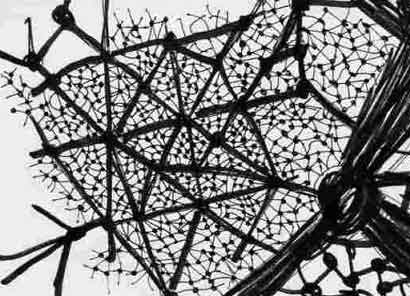

Introducing us the concept of rhizome, Deleuze uses a rhizome himself, not just a whatever book which would have innate a linear and sequential structure, that pinpoints and solves a problem, but an hypertext, with no conclusion in it, hard to understand as to define it, hard to extrapolate a unique sense because is the reader who has to look for it, every single reader putting himself, as just one of the infinite connections to which it is open, inside the text.
The operation which drives Deleuze to rhizome is the most philosophical action in philosophy; inspecting the philosophic experience, based on the thinking process, and on the effective difficulty of thinking, he studies and scrutinizes the thinking itself, tracing a map of it, forming a geophilosophy, the rhizome indeed.
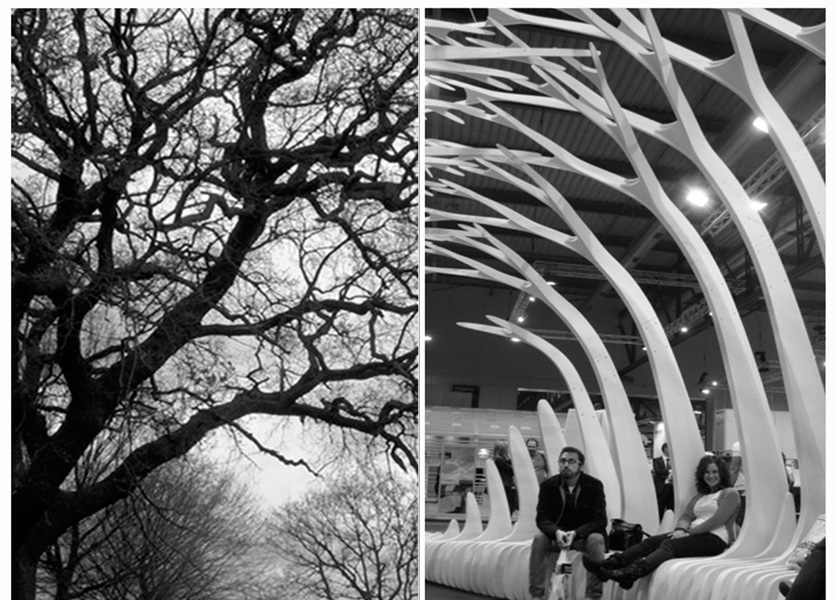
Thus, to understand its sense, I guess is necessary to do a step farer from the rhizomatic thinking system and give a look on what is at the rhizome’s antipodes. Opposed to the rhizome, deeply criticized by the author, and deeply embedded in the western thinking from Platone to nowadays, is the tree-roots system which legitimates itself by redirecting on a unique element, firmly submerged on the depths of a categorical system. The latter one is totally hierarchical, that from its own roots and their dichotomist propagating develops a logical-theoretical system, instead the rhizome is a network, which can develop itself in a scattered order, not by noted points and with off-center configurations, in which every element can be related to any other one, the tree is vertical, the rhizome is horizontal, the first one is diachronic, the other one is synchronic, the tree is an ordered succession and fundamentally dual, 1,2,4,8, in other words the multiple starting from a unity; the rhizome is multiplicity expressed n-1 where the 1 is the centralizing unity. The tree-roots is “from-to”, the rhizome is “between”; and still, one is “is” adjectival, ontological, the other one is “and”, of a conjunctive nature. The first one is evolution, the latter one is transformation, rigidity and flexibility, one is made by objects, the other one by relations. The tree is this paragraph, the rhizome is inside each one of us.
To better define the rhizome, Deleuze outlines six points: Connection and Heterogeneity the first ones, which is a composition of lines, of dimensions, directions, not of unities, and this allow the absolute interconnections inside it; the third point is Molteplicity, and this implies the absence of interdependency, the rhizome is open and infinitely travelable, with infinite entrances and exits. Fundamental is the fourth point, the Asiginifying Rupture, which pinpoints the behavior within it, a rhizome acts by variations, conquest, extension, and if a rupture occur this one becomes unpredictable experience of discovery, given by regenerative capacity of the system. The last two point go together too, Cartography and Decalcomania, the first one is positive as a sort of dynamic projection of the rhizome itself , the latter one is negative as it shelves and neutralizes the multiplicity.
As it couldn’t be in a different way, the rhizomatic thinking is born in the second half of the last century and it couldn’t be a better definition of the current one. Always opposing to the tree-system we live in a time with no roots, not continuous, cyclical and stable anymore, but in a process of demythicization of the past and in an increasing detachment from it, immerged in an hybrid and irregular present, conscious of an unpredictable, even close, future; what the tree doesn’t have, as well as all the centuries past, because all determined by process, is the simultaneity, the absolute present, the extraordinary self-sufficiency and self-determination of the rhizome and of 21st century.
Acquired the concept of rhizome, and aware that the rhizome is nothing also than a biological fact, and, in our case, an image of thinking, what about architecture? Get the rhizome as a model and make architecture an imitation of it, so a rizomathic architecture; or extending the rhizome thinking to every circumstance surround us, so thinking rhizomatically the architecture; or internalizing the architecture in a rhizomatic system? Well, both terms, belonging to distinct categories, don’t’ distinguish themselves that much; naturally implied, talking about rhizome as an advanced approach to philosophy, I’m always referring to advanced architecture. So what do they have in common? At the first sight the chaos, illusory, intended, that dynamic system of transitive transations, by territorializing and deterritorializing without loosing identity, a fake disorder made by a multiplicity of orders, of layers, of mille plateau, an undetermined result of trajectories and fluctuations, a fractal system sensible to variations. Both strongly heterogeneous, two non-linear system with no point of equilibrium, both in a continuous process, both a continuous process. But here it’s introducing a non-contact point; regarding what said before, the rhizome is atemporal, can we say the same about architecture? Yes and no. Because it’s undeniable that the essence of architecture, which differentiate it from other arts, is the time-space, but is also true that this one, made by objects, other distinction from rhizome, is deep-rooted in the perceivable world, and so the same objects, in the past as in the future, are just representation of architecture, and thus, architecture is the present instant, so rhizome. Referring to old problems, is the architect an atmosphere’s material, as the time for architecture, and so nothing, or the architecture is atmosphere, which I believe is a rhizome system, and so the architecture is a rhizome too? ? And more, Deleuze represents the image of a rhizome as body with no organs, but can the archietecture be really this, isn’it in the figure of the architect an idea of unicity, a generator organ? And maybe that n-1 is an architecture without architects as regarding B.Rudofsky?And every new assumption creates new doubts; how is it possible that a rhizome, as a root, comes from scientific determinations, but when gets close to architecture we find the latter one a rhizome just if we refer to the most humanistic disciplines within it. Given and not resolved those ambiguities, I do not believe the identification of one into another one is the right way; Deleuze wouldn’t appreciate it, rhizome refuses decalcomania.
I believe, maybe, that the rhizome, with no start and end point within it, could be itself the end and the beginning of the architecture; if the rhizome is a “between”, architecture is in between the rhizome.
Introducendoci al concetto di Rizoma, Deleuze, usa lui stesso un rizoma, non un libro qualsiasi che avrebbe insito quella struttura lineare e sequenziale, che individua e risolve un problema, ma un ipertesto, non concluso in sé, difficile a comprendersi come a definirsi, difficile a estrapolarne un senso unico perché è il lettore a doverlo cercare, ogni singolo lettore ponendo se stesso, come uno degl’ infiniti collegamenti esterni a cui esso è aperto, all’interno del testo.
L’operazione che porta Deleuze al rizoma è quanto di più filosofico v’è in filosofia; indagando l’esperienza filosofica, fondata sul pensiero, e sull’effettiva “difficoltà” di pensare, studia e approfondisce il pensiero stesso, tracciandone una mappa, costituendo una geofilosofia, il rizoma appunto.
Per capirne il senso, dunque, credo sia necessario scostarci dal sistema rizomatico di pensiero ed anche vedere cosa v’è agl’antipodi del rizoma. Opposto al rizoma, profondamente criticato dall’autore, e profondamente radicato nel pensiero occidentale da Platone fino ad oggi, v’è il sistema albero-radice, che si legittimizza nel reindirizzarsi ad un elemento unico stabilmente affondato nelle profondità del sistema categoriale. Quest’ultimo è totalmente gerarchico, che dalle proprie radici e dal loro propagarsi dicotomico sviluppa un sistema logico-teoretico, a differenza del rizoma che è invece una rete, che può svilupparsi in ordine sparso, non per punti noti, e con configurazioni decentrate, in cui ogni elemento può essere collegato ad un qualsiasi altro, l’albero è verticale, il rizoma orizzontale, il primo diacronico, l’altro sincronico, l’albero è successione ordinata e sostanzialmente duale, 1-2-4-8, ovvero il molteplice a partire dall’unità superiore…mentre il rizoma è molteplicità espressa in n-1 dove 1 è l’unità accentrante. L’albero-radice è “da-a”, il rizoma “tra”; ancora uno è “è” attributivo, ontologico, l’altro “e”, di natura congiuntiva. Il primo è evoluzione, il secondo trasformazione; rigidezza e flessibilità, uno è costituito da oggetti, l’altro da relazioni. L’albero è questo paragrafo, il rizoma è dentro di noi.
Per meglio definire il rizoma Deleuze delinea sei punti: Connessione ed Eterogeneità i primi, ovvero una composizione di linee, di dimensioni, direzioni, non di unità, e ciò consente l’assoluta interconnessione al suo interno; il terzo è Molteplicità, e il che sottintende assenza d’interdipendenza, il rizoma è aperto ed infinitamente percorribile, con infinite entrate ed infinite uscite. Fondamentale è il quarto punto, quello della Rottura Asignificante, che ne delinea il comportamento al suo interno, un rizoma procede per variazione, conquista, estensione, qualora sopraggiunga una rottura questa diviene imprevedibile esperienza di scoperta data dalle capacità rigenerative del sistema. Anche gl’ultimi punti vanno accomunati, e sono Cartografia e Decalcomania, positivo il primo in quanto una sorta di proiezione dinamica del rizoma stesso, negativo l’altro quando congela questo e ne neutralizza la molteplicità.
Come non poteva essere diversamente, il pensiero rizomatico è frutto della seconda metà dello scorso secolo e mai come di questo ne può essere una chiara definizione. Sempre in opposizione al sistema albero viviamo un tempo senza radici, non più continuo, ciclico o stabile, ma in un processo di demitizzazione del passato e in crescente distacco da esso, immersi in un presente ibrido e irregolare, cosciente di un imprevedibile, anche prossimo, futuro; ciò che l’albero non è e che tutti questi secoli non sono stati, perché determinati da processualità, è l’assoluta simultaneità, l’assoluto presente, un incredibile autosufficienza e autodeterminazione del rizoma e del 21esimo secolo.
Fatto proprio il concetto di rizoma, e consapevoli che rizoma altro non è che un fatto biologico, e, nel nostro caso, un’immagine del pensiero, che ne è dell’architettura? Prendere il rizoma a modello e farne dell’architettura un’imitazione di esso, cioè un’architettura rizomatica; o estendere il pensiero rizomatico ad ogni circostanza c’è di fronte, quindi pensare rizomaticamente l’architettura, o internare l’architettura in un sistema rizomatico? Ebbene, i due termini, appartenenti a due categorie ben distinte, non si distinguono tra loro poi tanto; presupponendo il rizoma un nuovo e avanzato approccio alla filosofia sottintendo cosi che per architettura parliamo d’architettura avanzata. Allora cosa hanno in comune? A prima vista il caos, apparente, s’intende, quel sistema dinamico di relazioni transitive, di territorializzazioni e deterritorializzazioni senza perdita d’identità, un finto disordine come un insieme di molteplici ordini, molteplici layers, o millepiani, frutto indeterminato di traiettorie e fluttuazioni, un sistema frattale sensibile alle variazioni. Ambedue fortemente eterogenei, due sistemi non-lineari e senza punti d’equilibrio, ambedue in un processo continuo, ambedue un processo continuo. Ma qui s’introduce un punto di non contatto; stando a quanto sopra il rizoma è atemporale, possiamo parlare allo stesso modo dell’architettura? Si e no; perché è innegabile che l’essenza dell’architettura, che la differenzia dalle altre altri, è nello spazio-tempo, ma è anche vero che questa, fatta di oggetti, altra distinzione dal rizoma, è radicata nel mondo sensibile, e che dunque gli stessi oggetti, nel passato e nel futuro, non sono che rappresentazioni dell’architettura, e dunque questa è l’istante presente, sicchè rizoma. Riferendoci e rialzando scorse problematiche, è l’architettura materiale dell’atmosfera, come il tempo lo è dell’architettura, e quindi nulla, o l’architettura è atmosfera, che credo sia un rizoma, e allora è rizoma anche l’architettura ?E ancora, Deleuze ci dàl’immagine del rizoma come un corpo senza organi, ma l’architettura può davvero essere questo, non v’è già nella figura dell’architetto quell’idea di unicità, quell’organo generatore? E forse quell’n-1 è un’architettura senza architetti come secondo Rudofsky E ogni supposizione incalza nuovi dubbi; com’è possibile che il rizoma, come radice, proviene da determinazioni scientifiche, ma nell’accostarsi all’architettura troviamo questa tale solo riferendoci alle discipline più umanistiche incluse in essa? Date e non risolte tali ambiguità non credo l’identificazione dell’una nell’altro sia la giusta via; Deleuze non lo approverebbe, il rizoma rifiuta decalcomanie.
Credo forse che il rizoma, senza né inizio né fine al suo interno, possa essere lui stesso inizio e fine dell’architettura; se il rizoma è un “tra”, l’architettura è “tra” il rizoma.
Giacomo Fiorani- Hormezi – 2013
Photo by Giacomo Fiorani