Category Archives: Digital Logics – Critical Readings

Development of the Cybernetic Era: Technologic Humanism

Enterprise-E_LCARStechnology

How do you build a Learning Machine?

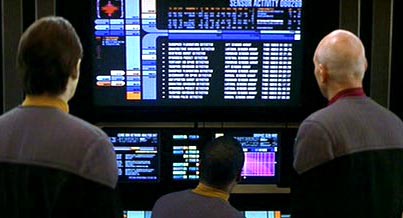
In 1968, the idea of computer aided participatory design was a  foreign concept for architects. The typical architectural office was comprised of people sitting and standing composing construction and design documents in front of large desks from morning till night. An Architectural theorists, Nicholas Negroponte, at this time was theorizing about what the world would be like if architects had machines that could compute, process, and share information. Negroponte was thinking about creating a system where the computer would be capable of handling the small details as well as helping the architect manage all aspects of a large scale project. Thus, allowing the designer/user/architect to focus more on the important aspects of the design. 20 years before advanced computer aided design systems and software was designed, Negroponte was asking questions. Can a machine learn about architecture? Can machines learn about learning about architecture? Can a machine be designed to repeat tasks? Yes! Can they associate courses of action with goals? Can they be self improving?  Simultaneously being ethical?

Read More »

Also posted in Carmen Aguilar y Wedge, Digital Logics - Critical Readings | Tagged , , | Comments closed

Parametricism a synergy to Futurism? or Architecture?

T-6 Parametricism

Patrik Schumacher

Parametricism

” Each space is in fact a communication. It invites its visitors to participate and gives them clues on how should they behave, what to do. But people are no longer satisfied with simple ordering of space with rigid forms and strict compartmentalization. They need to communicate with each other and move swiftly. This is why rooms should not be separated but rather interconnected. Spaces should be constructed in such a way that everyone can easily see, find and communicate with everyone else.”-Schumacher Read More »

Also posted in Christoffer Ryan Chua, Digital Logics - Critical Readings | Tagged , , , | Comments closed

Rhizome – An Image Of Thought.

Marc-Ngui

Book: A Thousand Plateaus: Capitalism and Schizophrenia
Author: Gilles Deleuze and Felix Guattari
Chapter: I- Rhizome


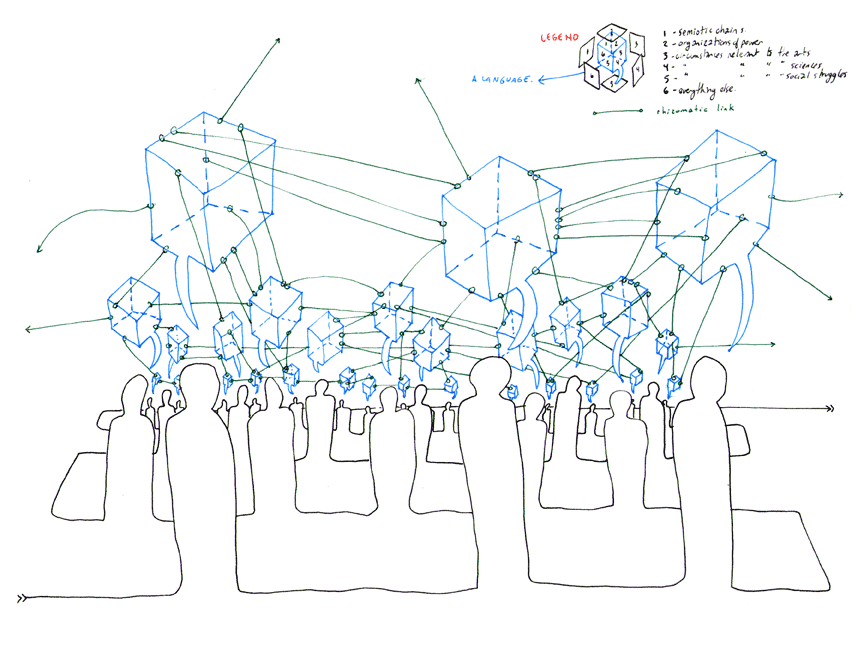
“Any point of a rhizome can be connected to anything other, and must be;” and, ”A rhizome ceaselessly establishes connections between semiotic chains, organizations of power, and circumstances relative to the arts, science, and social struggles.”


The rhizome is one of two forms of organization. It’s easier to start with its antithesis, the ‘arborescent’ form.Something that’s ‘arborescent’ has an ordering, a hierarchy, a defined structure. The word comes from a tree, and that’s the primary image: all of the branches start from the trunk and spread outward. They also use a book example: a book’s binding is like the trunk of a tree, and the pages are branches.A rhizomatic structure is different: it’s a twisty, non-linear, network, rather than a unified structure. It may have many beginnings and endings, twisty little passages.It  is a labyrinth or  structure of passageways and is marked by some properties that distinguish from the occidental history of  labyrinth.It has no beginning nor end  and is without Ariadne thread – A Labyrinth  without center and periphery  .

http://www.youtube.com/watch?v=pQBkNfWE7_k&list=PLD26D32914EA1B4A8


Also posted in Asif Rahman, Digital Logics - Critical Readings | Comments closed

Deleuze and the genesis of form

The essay written by Manuel DeLanda in discusses the genesis of form, according to the philosophy of Gilles Deleuze. Matter, for Deleuze, has spontaneous behavior (inertia) and the resources involved in the genesis of form are immanent to matter itself. Examples of form genesis in nature help to understand that the two factors governing the creation of the differentiated instantiations are mathematics and thermodynamics. Difference in “intensity” provides the energy flow from which form emerges. The two basic types of structures, for Deleuze, are the “strata” and the “self-consistent aggregates”, or the “tree” and the “rhizomes”. Both result in isomorphic actual forms, but the one has to do with the synthesis of homogenous elements while the other explains the consolidation of heterogeneous elements. These principles that organize socio-technics, biological and molecular structures can be distilled into diagrams that can be used to govern virtual meshworks and other genesis.

All texts of the assignment deal, in a way, with the creation of form. Deleuze’s philosophical study on rhizomes explains their form structure principles. Their creation and evolution seems random, but follows certain notable rules. Thomson investigates shapes and their alternations. Forms found in nature can be analyzed on grid systems and their variations can be categorized and reproduced by specific mathematical transformations. Johnson examines ant colonies and their strategy of creation. Each ant has a particular role in the formation of an overall complex structure. Negroponte searches for the ideal architectural design tool. Almost prophetically, he envisions a Machine that will work with the architect and will calculate anything he himself is not able to. Finally, Schumaker talks about parametrics as an architectural style. How pure mathematic calculations can lead to the creation of complex forms and why this technology has such impact on contemporary architecture.

Form creation in nature can be seen emerging in many different, yet specific morphological patterns. These patterns vary, transform, coexist and evolve, and are found in all life forms. From simple to understand structures, like the nautilus shell, to complex ones, like a tree, patters are ubiquitous. As digital logics deal with parametrics, these patters could be studied, reproduced, simplified and explained with the help of digital tools. This analysis could be an interesting field of study that would explain why certain patterns best suit specific functions and climates. This can inspire us on their application in architecture, so that a choice of a pattern that will govern the architectural design of a building can be a matter, not only of aesthetics, but also of its function and position.
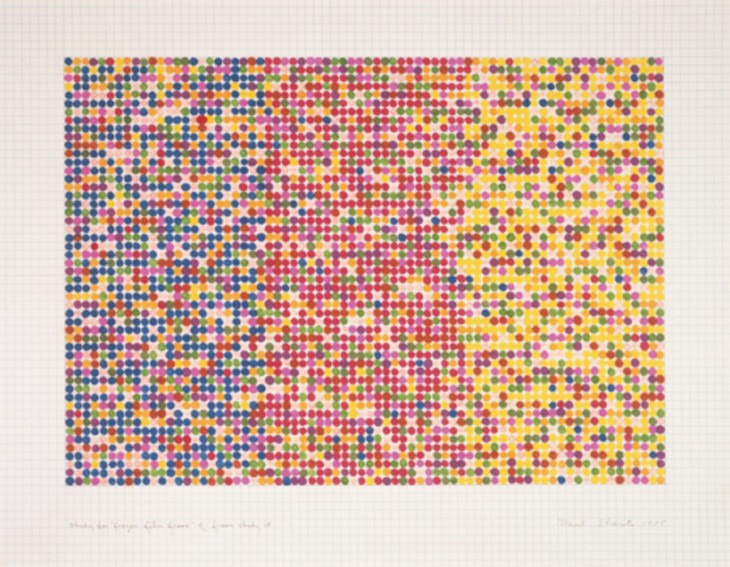
Paul sharits Study for Frozen Film Frame of Frame Study 15, 1975Paul Sharits – Study for Frozen Film Frame of Frame Study 15, 1975 (source: http://www.artslant.com)

Also posted in Digital Logics - Critical Readings, Dimitrios Aidonis | Comments closed

Retro Futurism

moma_kraftwerkretrospective_manmachine

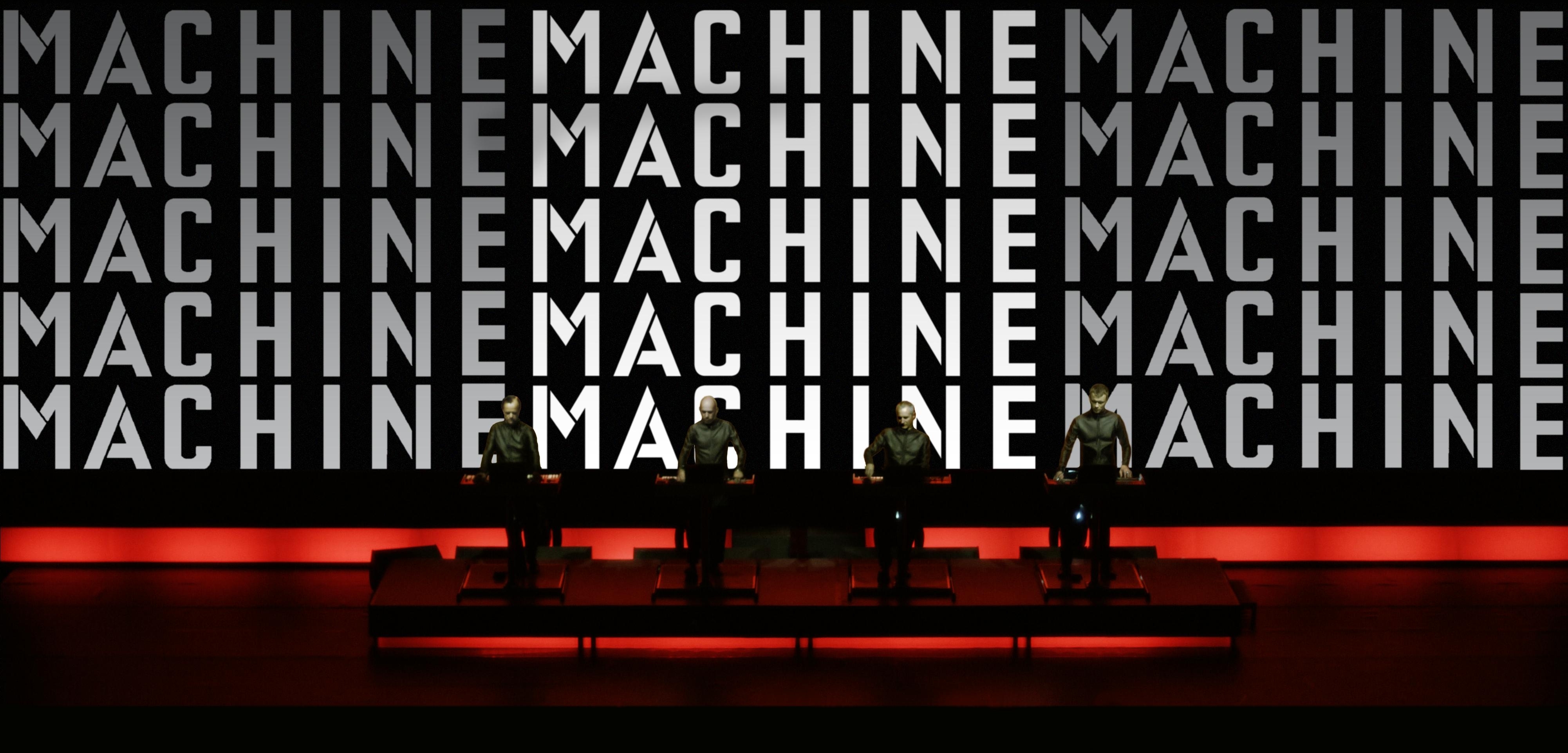
Rebecca Allen visuals for Kraftwerk concert at MoMA // 2012. Rebecca Allen is the current creative director for Nicholas Negroponte’s projects.  image courtesy of MoMA (source)

assigned reading: ‘Toward a Theory of Architecture Machines’  by Nicholas Negroponte , 1969.

Today, the widespread use of computer-aided design has created a paradigm shift in the way architecture is conceived, represented and fabricated. The expressive and constructive potential of the digital has been -and still is- thoroughly studied by theorists and architects who’s position towards the digital is one of admiration or skepticism or both. It is obvious that machines have enabled designers to overcome the traditional constraints of thought and set the grounds for a higher level of formal and programmatic complexity with numerous aesthetic, functional and performative implications. But even with these advantages, architecture still remains in the hands of the architects who carry the professional expertise to successfully translate the user’s needs and desires into design. This disciplinary enclosure is further accentuated by the growing sophistication of digital architecture. Often it deploys an unfamiliar vocabulary, emphasises the role of the “expert” and makes the process of architectural design increasingly inaccessible to the user.

Read More »

Also posted in Digital Logics - Critical Readings, Ruxandra Iancu Bratosin | Tagged , , , | Comments closed